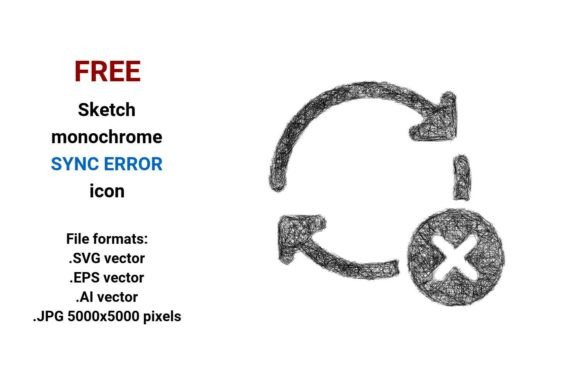
FREE Sketch Sync Error Icon: A Practical Resource for Clear Visual Communication
When a synchronization fails—whether in cloud storage, design collaboration tools, or data pipelines—the message needs to land instantly. A well-designed icon does more than signal trouble; it guides attention, supports user understanding, and maintains interface consistency. The FREE Sketch Sync Error Icon delivers that clarity with intention. It’s not just another error symbol—it’s a hand-drawn, sketch-style vector asset built for real-world digital workflows where tone, scalability, and compatibility matter.
What Makes This Icon Different—and Why It Matters
This isn’t a generic red “X” or a flat system alert. The FREE Sketch Sync Error Icon uses a deliberate sketch aesthetic: visible line weight variation, subtle imperfections, and organic flow. That sketchy quality communicates approachability without sacrificing professionalism—ideal for apps, dashboards, or educational platforms where users need reassurance alongside information. Because it’s delivered in four native formats—.SVG, .EPS, .AI, and .JPG (5000×5000 px)—it adapts seamlessly whether you’re editing in Figma, refining in Illustrator, embedding in HTML, or printing at scale.
A vector image like this is defined by mathematical paths—not pixels—so resizing introduces no blurring or distortion. That means the same icon works equally well as a 16×16 favicon, a 120×120 mobile button, or a full-screen illustration in a troubleshooting guide. No reworking. No quality loss. Just consistent visual language across devices and contexts.
Where It Fits Into Your Workflow
You don’t wait until an error occurs to prepare for communication. The FREE Sketch Sync Error Icon belongs in your asset library *before* launch—not after a bug report arrives. Designers embed it during UI mockup phases. Developers reference it when building sync status components. Educators use it in training materials to illustrate what a failed data transfer looks like. Marketers include it in onboarding flows to reduce support tickets around misconfigured integrations.
For freelancers and small teams, having this icon pre-vetted and production-ready saves time spent sourcing, licensing, or redrawing assets. It integrates cleanly into existing design systems—especially those prioritizing human-centered aesthetics over sterile minimalism. If your product uses doodle-style illustrations elsewhere (e.g., empty states, loading animations), this icon extends that voice cohesively.
Compatibility and Implementation Tips
All four file formats serve distinct roles:
- .SVG: Best for web use—lightweight, responsive, and accessible via inline code or CSS background. Supports color overrides and animation (e.g., pulsing on repeated failures).
- .AI and .EPS: Ideal for designers who need editable layers, anchor points, or precise path adjustments. Use these when customizing stroke behavior, adding branding elements, or adapting the icon for dark/light mode variants.
- .JPG (5000×5000 px): A high-res fallback for print, presentations, or platforms that don’t support vectors natively. Maintains crispness even when scaled down for thumbnails or social previews.
Because the icon is black-and-white, it’s inherently flexible. You control contrast and color context—apply a warning orange fill in your app’s error state, or invert it to white-on-dark for accessibility compliance. No need to request alternate versions. Just import, adjust, and deploy.
Using It Across Stages of a Project
Before development: Include the icon in your design system documentation so developers know which asset represents sync failure—and why its sketch style matters for tone alignment. Pair it with microcopy (“Sync interrupted. Try again?”) to reinforce meaning.
During testing: Use the .JPG version in test environment screenshots to simulate realistic error conditions for QA reviewers. Its resolution ensures clarity in bug reports and stakeholder reviews.
After launch: Drop the .SVG into your analytics dashboard to flag failed API calls or stale dataset updates. Since it scales infinitely, it remains legible even when embedded in dense monitoring views.
For educators and content creators, the sketch aesthetic lowers cognitive load—making technical concepts like synchronization error feel less intimidating. Insert it beside explanations of latency, conflict resolution, or offline-first architecture to anchor abstract ideas in visual form.
Long-Term Value and Consistency
Unlike raster-only icons that degrade with each resize or export, this set stays future-proof. As your product evolves—adding new platforms, themes, or localization—you won’t need to re-purchase or re-create the asset. The .AI and .EPS files let you generate new variants (e.g., animated versions, RTL-flipped layouts) without relying on external vendors.
Consistency also extends to team collaboration. When everyone uses the same sync error icon, users build mental models faster. They recognize the pattern across features—file sync, calendar sync, CMS publishing—reducing learning overhead and support volume. That predictability is especially valuable for non-technical users: small business owners managing inventory feeds, teachers syncing student submissions, or bloggers updating cross-platform content.
Practical Integration Examples
UX Writers: Embed the SVG directly into error modals with descriptive alt text (“Sketch-style sync error icon: two overlapping arrows with a diagonal slash”). This satisfies both accessibility standards and SEO best practices for image context.
Frontend Developers: Import the SVG as a React component or Vue directive. Use CSS variables to dynamically change stroke color based on severity—yellow for warnings, red for critical failures—while preserving the original sketch texture.
Content Strategists: Repurpose the .JPG in knowledge base articles titled “How to Fix a Synchronization Error.” Its visual clarity helps users scan and self-diagnose before contacting support.
Product Managers: Use the .AI file to annotate wireframes showing how the sync error button behaves in different states—hover, active, disabled—ensuring engineering and design align early.
Final Considerations for Real-World Use
Don’t treat this icon as decoration. Treat it as part of your error-handling infrastructure. Its sketchy, hand-drawn character signals empathy—not indifference—to users experiencing friction. That nuance builds trust, especially in tools where reliability is expected but not guaranteed (e.g., offline-capable apps, collaborative editors, IoT dashboards).
Also consider pairing it with complementary assets: a sync success icon (same sketch style), a sync in progress animation, or a data sync flowchart. Consistent visual language across related states strengthens comprehension far more than isolated icons ever could.
If you're evaluating this FREE Sketch Sync Error Icon against alternatives, ask: Does it scale without compromise? Does it match my brand’s voice? Can my team use it across tools without friction? Does it support—not obscure—the message? When the answer is yes to all three, you’ve found more than an icon. You’ve found a reliable, reusable piece of your communication stack.