FREE Sketch Carbon Capture Icon: A Practical Resource for Designers and Developers
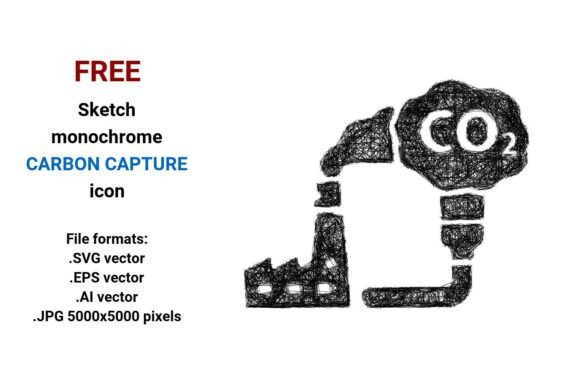
The FREE Sketch Carbon Capture Icon is a set of four high-fidelity, hand-drawn style icons focused on carbon capture—designed specifically for clarity, adaptability, and visual consistency across digital interfaces. Unlike photorealistic or overly technical illustrations, this collection leans into a clean, approachable sketch aesthetic: light linework, subtle imperfections, and intentional negative space. It includes one core icon rendered in four widely supported file formats—.SVG, .EPS, .AI, and a high-resolution .JPG (5000×5000 pixels). This makes it usable both in vector-based workflows (for scaling, editing, and integration into design systems) and in raster-dependent contexts like presentations or documentation where pixel-perfect fidelity matters.
What Sets This Icon Apart from Other Carbon Capture Visuals
Most carbon capture-related graphics fall into one of two categories: highly technical schematics (e.g., industrial scrubber diagrams) or abstract, corporate-style symbols (e.g., stylized leaves with CO₂ molecules). The FREE Sketch Carbon Capture Icon occupies a middle ground—it communicates the concept of co2 capture without requiring domain expertise to interpret. Its line sketch style evokes accessibility and human intention, making it well-suited for educational platforms, sustainability dashboards, climate literacy tools, or civic engagement sites.
Crucially, it’s built as a vector image: meaning every curve, stroke, and junction is defined mathematically—not as fixed pixels. That allows designers to resize it from a 16-pixel favicon to a full-screen banner without blurring or distortion. Because it’s delivered in native .AI and .EPS formats, users can open and modify layers, adjust stroke weight, recolor paths, or isolate elements—something not possible with flattened JPGs or low-res PNGs.
Comparing Formats: When to Use Which File Type
Having all four formats in one package adds flexibility—but each serves a distinct purpose:
- .SVG: Ideal for web use. Embed directly in HTML, style with CSS (e.g., change stroke color on hover), and ensure crisp rendering on any screen density. Best for UI buttons, interactive dashboards, or responsive websites needing carbon capture button functionality.
- .EPS: A legacy but still widely accepted vector format, especially in print production and older desktop publishing software. Useful if you’re preparing assets for brochures, reports, or PDF-based stakeholder materials where precise line fidelity matters.
- .AI: Native Adobe Illustrator format. Offers full editability—including layer structure, text objects (if present), and path manipulation. Recommended if you plan to customize stroke behavior, integrate with existing brand guidelines, or build a larger icon system around this base.
- .JPG (5000×5000 px): High-resolution raster version. Suitable when vector support isn’t available—such as in certain CMS editors, email clients, or legacy presentation tools. While not scalable without quality loss, its resolution ensures clarity even when zoomed or printed at poster size.
This multi-format delivery avoids forcing users into a single workflow. You’re not locked into one ecosystem—or forced to convert files and risk degradation.
Strengths and Real-World Fit
The FREE Sketch Carbon Capture Icon excels in contexts where tone and clarity matter as much as function. For example:
- A university climate science outreach team building an interactive web module might use the .SVG version inside a D3.js visualization—changing its color dynamically as CO₂ levels shift.
- A nonprofit designing a campaign toolkit could drop the .AI file into their brand kit, adjusting line thickness to match their typography hierarchy before exporting variations for social media, slide decks, and posters.
- A government agency publishing a public-facing dashboard might embed the .SVG as a clickable carbon capture icon that expands into a tooltip explaining sequestration methods—leveraging its scalability and interactivity.
Its hand drawn sketch and doodle style icon qualities also help soften complex environmental topics. In user testing, similar sketch-style icons have shown higher comprehension among non-specialist audiences compared to dense technical icons—especially when paired with plain-language labels.
Limitations and When to Consider Alternatives
While versatile, this icon isn’t optimized for every scenario. It’s intentionally minimal—so it doesn’t illustrate specific capture technologies (e.g., direct air capture vs. post-combustion scrubbing). If your project requires technical accuracy—for instance, an engineering white paper comparing capture efficiencies—you’d likely need annotated diagrams or custom illustrations instead of a symbolic co2 capture icon.
Similarly, the sketch aesthetic prioritizes warmth over formality. That makes it less suitable for regulatory filings, formal policy documents, or enterprise-grade B2B software where visual language tends toward precision and restraint. In those cases, a clean line art or monochrome ui icon with geometric rigor may align better with audience expectations.
It’s also worth noting: while the icon is labeled “free,” always verify licensing terms before commercial deployment. Some free resources restrict use in paid products or require attribution—even if not immediately obvious from the download page.
How It Fits Within Broader Design and Communication Needs
Designers evaluating carbon capture icons often weigh tradeoffs between recognizability, scalability, tone, and technical fidelity. The FREE Sketch Carbon Capture Icon leans decisively into recognizability and tone—using familiar visual cues (a simplified molecule, upward arrows suggesting removal, gentle enclosure) without overloading the composition. That supports quick scanning in UI layouts, especially alongside other ui button elements like “Learn More” or “Calculate Impact.”
Its black-and-white foundation gives designers room to adapt: apply brand colors via SVG fill properties, overlay on gradients, or pair with complementary icons in the same sketch style to build a cohesive visual language. That modularity supports long-term maintainability—unlike bespoke illustrations that require rework for each new use case.
For teams building climate-focused digital tools, having a consistent, editable, and technically sound vector carbon capture button reduces friction across design, development, and content roles. It eliminates the need to commission custom assets for basic interface needs—or rely on generic clipart that lacks conceptual accuracy.
Making an Informed Choice
If your goal is to communicate carbon capture concepts clearly and empathetically—to students, community members, or cross-disciplinary collaborators—the FREE Sketch Carbon Capture Icon offers strong value. Its combination of sketch-style approachability, vector flexibility, and multi-format availability makes it more adaptable than many single-format alternatives.
But if your work demands strict technical representation, formal visual standards, or integration into a tightly controlled design system with strict iconography rules, you may benefit from commissioning custom assets—or selecting a more standardized icon set aligned with your organization’s broader UI language.
Ultimately, the right choice depends less on what’s “best” in absolute terms—and more on how well a resource fits your specific communication goals, technical constraints, and audience needs. The FREE Sketch Carbon Capture Icon earns its place where clarity, adaptability, and human-centered expression are priorities—not just visual decoration.