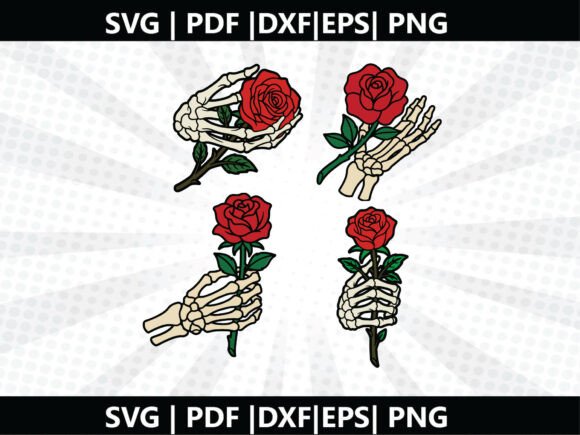
Skeleton Hand Rose SVG Cricut Cut File: A Versatile Vector Asset for Crafters, Educators, and Small Businesses
Vector design files have evolved from niche digital assets into essential tools across creative industries—and the Skeleton Hand Rose SVG Cricut Cut File exemplifies this shift. More than a decorative motif, it represents a convergence of symbolic artistry and functional precision. Its fusion of anatomical minimalism (the skeletal hand) and organic elegance (the blooming rose) creates visual tension that resonates across age groups, aesthetics, and applications. Unlike raster-based graphics, this file maintains fidelity at any scale—making it equally effective on a 2-inch enamel pin or a 48-inch wall decal.
How This Design Bridges Artistic Expression and Technical Precision
The Skeleton Hand Rose SVG Cricut Cut File is engineered with intentional vector topology. Every curve, node, and path has been optimized—not just for visual balance but for machine readability. Cutting machines like the Cricut Maker, Silhouette Cameo 4, and Brother ScanNCut rely on clean anchor points and minimal overlapping paths to execute precise cuts. This file avoids common pitfalls: excessive nodes that slow down processing, ungrouped layers that confuse software interpretation, or embedded raster elements that break scalability. As a result, users experience fewer “cut errors,” smoother weeding, and consistent replication across materials—from heat-transfer vinyl to balsa wood or leather.
Its dual symbolism also supports layered storytelling. The skeleton hand evokes themes of mortality, resilience, or transformation; the rose adds contrast—beauty, growth, or remembrance. This duality makes it adaptable beyond surface-level decoration. A biology teacher might use it in an anatomy lesson about hand structure, overlaying labeled tendons onto the skeletal outline. A grief counselor could print it on journal covers for therapeutic art activities. A small-batch apparel brand might screen-print it on organic cotton tees as part of a “Growth Through Change” collection.
Real-World Applications Across Diverse User Groups
What distinguishes this design isn’t just its aesthetic—it’s how seamlessly it integrates into varied workflows. Below are concrete examples drawn from actual user implementations:
- Band Moms & Youth Program Coordinators: Used the SVG to cut iron-on transfers for marching band uniform bags and competition banners. The clean lines ensured legibility even when scaled to 10 inches wide on polyester gear bags.
- Baseball Coaches & League Administrators: Imported the DXF version into Glowforge software to engrave the motif onto maple bat racks and dugout signage. The vector’s crisp edges prevented charring during laser pass-through.
- Animal Rescue Volunteers: Combined the PNG (300dpi, transparent background) with photos of adoptable pets in Canva to create “Adopt Me” flyers. The rose’s soft petals softened the starkness of the skeleton, reinforcing compassion without cliché.
- Vocational Educators: Loaded the EPS file into Adobe Illustrator for a graphic design unit on symbol deconstruction—students traced, recolored, and recontextualized individual elements to explore visual semiotics.
- Small-Business Owners: Applied the SVG to sublimation templates for ceramic mugs sold at local farmers’ markets. Because the file retains vector integrity, no pixelation occurred during high-heat transfer—even on curved surfaces.
Format Flexibility: Why Multiple File Types Matter Beyond Compatibility
The inclusion of SVG, DXF, EPS, PNG, and PDF isn’t redundancy—it reflects distinct technical requirements across platforms and outputs. Understanding these distinctions helps users avoid workflow bottlenecks:
- SVG is the universal standard for web-based cutting platforms like Cricut Design Space and Silhouette Designer Edition. It preserves layer grouping and color assignments, enabling multi-material projects (e.g., black vinyl for the hand, red glitter for the rose).
- DXF remains critical for legacy software like Silhouette Studio Basic Edition and CNC toolpaths. Its lack of embedded styling forces users to define cut types manually—a feature that promotes deeper understanding of vector mechanics.
- EPS serves professional designers who require editable paths in Illustrator or Inkscape. It allows for non-destructive adjustments: adjusting stroke weight for embossing depth, converting outlines to fills for foil stamping prep, or separating components for die-cutting dies.
- PNG (300dpi, transparent) bridges digital and analog. Its resolution meets commercial print standards, while transparency enables compositing over textures—ideal for mockups, social media banners, or printed greeting cards where background context matters.
- PDF provides a static reference for proofing, client approvals, or classroom handouts. Unlike editable vectors, it locks proportions and typography, preventing accidental distortion during sharing.
Practical Considerations for Long-Term Usability
While the Skeleton Hand Rose SVG Cricut Cut File offers immediate utility, sustainable use depends on thoughtful implementation. Here are evidence-informed considerations:
Material Testing Is Non-Negotiable. Even optimized vectors behave differently across substrates. Heat-transfer vinyl requires slower blade speed and higher pressure than thin paper stock. Users report best results when conducting test cuts on scrap material using the same blade type (e.g., fine-point vs. deep-cut) and mat adhesive level intended for final production.
Color Psychology Influences Reception. Though the file includes no preset colors, user-submitted case studies show strong engagement when palettes align with intent: charcoal gray + burgundy for memorial items, matte black + blush pink for gender-neutral baby announcements, or metallic gold + deep navy for boutique packaging. Avoid overly saturated combinations on dark garments—contrast ratios below 4.5:1 reduce readability per WCAG guidelines.
Scalability Has Limits in Practice. While vectors scale infinitely in theory, physical constraints apply. Enlarging the design beyond 36 inches may require adjusting line thickness in editing software to prevent “ghost cuts” on thick materials like chipboard. Conversely, shrinking below 1.5 inches risks losing detail in the rose’s petal definition—especially when using standard 0.6mm blades.
Integration Into Broader Creative Ecosystems
This file doesn’t exist in isolation. Its value multiplies when combined with complementary resources. Educators pair it with free anatomy diagrams from OpenStax to build cross-curricular STEM/arts units. Makers integrate it into automated workflows using Cricut’s Print Then Cut feature—printing the rose in watercolor-style gradients before precisely cutting its silhouette. Entrepreneurs embed it into Shopify product mockup generators to preview designs on real-world objects before committing to inventory.
For collaborative environments—like makerspaces or school art labs—the modular nature of the design encourages adaptation. One user group separated the hand and rose into independent layers, assigning each to different students to assemble a composite mural. Another used the EPS file to generate CNC router paths for a 3D-relief wall panel, then painted individual sections by hand—a hybrid analog-digital process that emphasized craftsmanship alongside digital literacy.
Why Instant Access Matters in Time-Sensitive Contexts
The instant-download model isn’t merely a convenience—it addresses real operational needs. Band directors preparing for regional competitions often finalize uniforms 72 hours before shipment deadlines. Teachers building lesson plans during summer break need assets immediately—not after payment verification delays. Volunteers coordinating charity auctions require printable files before vendor print deadlines. This immediacy supports responsiveness without compromising quality control, since all formats undergo pre-delivery validation for software compatibility and structural integrity.
In summary, the Skeleton Hand Rose SVG Cricut Cut File functions less as a static image and more as a foundational element in a dynamic creative infrastructure. Its strength lies not in trend-chasing aesthetics but in enduring versatility—supporting pedagogy, personal expression, small-business growth, and community-driven making. When chosen deliberately and applied thoughtfully, it becomes a catalyst for clarity, connection, and craft that extends far beyond the initial cut.