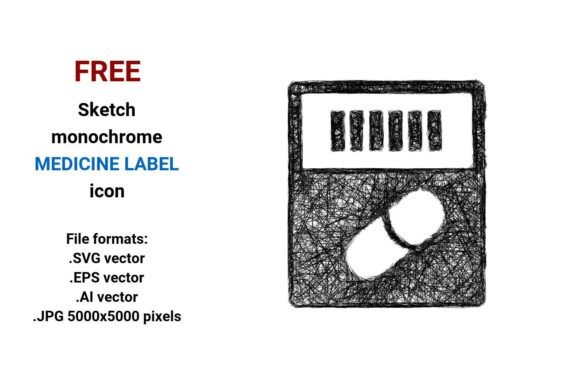
FREE Sketch Medicine Label Icon
If you're designing for healthcare, wellness, or pharmaceutical brands—or even crafting educational materials, blog graphics, or indie apothecary packaging—you’ll appreciate how effortlessly the FREE Sketch Medicine Label Icon bridges clarity and character. It’s not a sterile, clinical symbol—it’s a hand-drawn, monochrome label icon with gentle stroke variation, subtle imperfections, and quiet confidence. Think of it as a pharmacist’s handwritten note made digital: legible at a glance, warm on the page, and unmistakably human.
A Vector Icon Built for Real Work
This isn’t just another clipart-style download. The FREE Sketch Medicine Label Icon comes in four production-ready formats: .SVG, .EPS, .AI, and a high-res .JPG (5000×5000 pixels). That means whether you’re dropping it into Figma for a telehealth app UI, scaling it across a 36” pharmacy banner, embedding it in an InDesign patient brochure, or exporting a crisp PNG for social media—there’s no pixelation, no quality loss, no guesswork. Because it’s a vector image, every curve, corner, and stroke is mathematically defined—not a grid of fixed pixels. You can stretch it to billboard size or shrink it to a 16px favicon button, and it stays sharp, consistent, and intentional.
Where This Sketch Style Actually Shines
Sketch aesthetics thrive where trust meets approachability. A rigid, ultra-modern icon might feel cold beside a holistic wellness brand; a glossy 3D render could clash with a handmade herbal tea label. But this sketch medicine label icon lands right in the middle: professional enough for a clinic website header, expressive enough for a yoga studio’s supplement guide, minimal enough for a clean SaaS dashboard. We’ve seen it used well in:
- Pharmacy websites and apps—as a navigation button (“Medication Labels”) or status indicator next to prescription items;
- Educational printables—paired with anatomy illustrations or dosage charts for nursing students;
- Packaging design—subtly stamped onto kraft paper labels for organic tinctures or CBD products;
- Social media carousels—as a recurring visual anchor in “Medication Safety Tips” series;
- Internal training decks—helping frontline staff quickly identify drug labeling protocols.
It works because it doesn’t shout. It supports—not distracts. And unlike many “hand-drawn” icons that lean cartoonish or overly decorative, this one keeps its lines purposeful and grounded. No excessive flourishes. No forced quirk. Just honest, readable label form language—rectangle base, slight tilt, centered cross or pill shape, clean negative space.
Why Monochrome + Sketch = Stronger Brand Signals
Color carries weight—and sometimes, it carries baggage. A red cross may evoke emergency; blue suggests trust but risks blending in; green implies natural but can misfire in clinical contexts. Going monochrome removes ambiguity. It lets your brand palette do the emotional work while the drug label icon handles function. Paired with a restrained sans serif like Inter or a warm serif like Lora, it creates hierarchy without hierarchy overload. On a white background? Crisp and authoritative. Over a textured linen swatch or soft gradient? Instant tactile warmth.
We’ve noticed designers using the sketch medicine label icon most effectively when they treat it as a *design element*, not just decoration. For example: aligning its baseline with body text for consistency in a medical FAQ section; mirroring its stroke weight in custom dividers; or duplicating and rotating it slightly to create a subtle watermark pattern behind a privacy policy page. That’s the power of vector + sketch: flexible, repeatable, and deeply integrated.
Practical Tips Before You Download
First—yes, it’s truly free. No watermarks. No attribution required (though a credit is always appreciated). And yes, it’s cleared for commercial use: blogs, client projects, product packaging, Shopify stores, newsletters—even white-labeled health tech dashboards.
Before dropping it in, ask yourself:
- Does the stroke weight match my other UI elements? At small sizes (under 24px), test how legible the inner cross or pill motif remains. If needed, simplify in Illustrator by expanding strokes and uniting shapes.
- How does it pair with your type? Try it alongside your heading font at 1.5× line height—does the rhythm feel balanced? Sketch icons often breathe best with clean, open typefaces—not tight, condensed ones.
- Is contrast sufficient for accessibility? In .JPG or exported PNG use, verify it meets WCAG 4.5:1 contrast against its background, especially if used in forms or alerts.
- Are you using the vector files correctly? Open .AI or .EPS only in vector-native apps (Illustrator, Affinity Designer, Inkscape). Don’t rasterize unnecessarily—keep layers editable for future tweaks.
One real-world observation: designers who convert the .SVG into a CSS icon font (using IcoMoon or similar) report faster load times and easier theming—especially when building reusable component libraries for healthcare startups.
More Than Just an Icon—A Consistency Anchor
In branding, repetition builds recognition. Using the same medicine label vector across your website, printed handouts, email headers, and even staff lanyards quietly reinforces professionalism. It tells users: *This is how we signal safety, accuracy, and care.* Not through jargon—but through a shared visual shorthand.
That’s why so many small business owners—think compounding pharmacists, naturopathic clinics, or herbal educators—return to this sketch medicine label icon. It’s not flashy. It doesn’t try to be everything. It simply does one thing very well: help people see “label,” “medicine,” and “trust” in under half a second.
Whether you’re finalizing a patient portal wireframe or sketching ideas for a new supplement line, keep this icon in your toolkit. Not as filler—but as a quiet, confident voice in your visual language.