FREE Sketch Marketing Funnel Icon
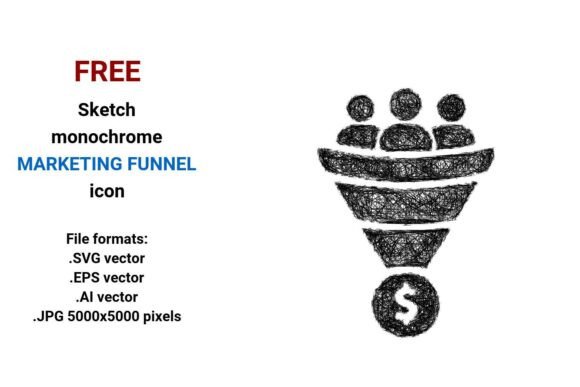
If you’ve ever stared at a blank slide, wireframe, or landing page wondering how to visually communicate the journey from “first click” to “final purchase” — without looking like a stock photo catalog — then the FREE Sketch Marketing Funnel Icon might be exactly what your project needs. It’s not another sterile, overused gradient funnel. It’s a hand-drawn, expressive, intentionally imperfect line-art icon that says “this is human-driven marketing” — not algorithmic automation.
Where This Sketch Marketing Funnel Icon Fits in Real Work
Designers, marketers, educators, and startup founders use this icon where clarity meets character — especially when the goal isn’t just to explain a process, but to invite engagement. Think of it as visual shorthand with warmth.
A UX designer sketching a SaaS onboarding flow might drop the sketch marketing funnel icon into a Figma wireframe next to “Email Capture → Demo Signup → Trial Activation.” Its handdrawn quality signals “this is still evolving,” which builds trust during early-stage feedback sessions.
A nonprofit communications lead building a donor journey map? They’ll paste the free sketch black and white marketing funnel icon into a printed workshop handout — its clean outline and subtle hatch texture hold up beautifully on recycled paper, unlike glossy vector icons that look out of place beside handwritten notes.
An e-commerce founder crafting a Shopify homepage banner might layer the sales funnel icon behind a headline like “From Curious to Confident — in 3 Steps.” Because it’s a vector image, they scale it to 200px wide for mobile and 800px for desktop — same crisp lines, zero pixelation.
Why Four File Formats Matter (and When You’ll Reach for Each)
This isn’t just one icon with four names. Each format serves a distinct workflow:
- .SVG vector: Your go-to for websites, email templates, and modern CMS platforms. It loads fast, respects dark mode, and responds cleanly to CSS color overrides — perfect if you want the same sketch icon to appear navy on your blog and coral on your CTA button.
- .EPS vector: The quiet workhorse for print designers. Use it when prepping pitch decks for agency clients, investor one-pagers, or conference handouts — EPS embeds reliably in Adobe InDesign and Illustrator, even across older versions.
- .AI vector: If you’re deep in Adobe Illustrator and need to tweak stroke weight, adjust spacing between funnel stages, or recolor individual layers — this is your editable source file. Ideal for customizing the conversion funnel icon to match your brand’s exact pencil-line aesthetic.
- .JPG (5000x5000 pixels): Not for scaling — but for situations where vector isn’t supported. Think PowerPoint presentations shared with stakeholders using outdated Office versions, social media carousels in Canva, or quick mockups in tools that don’t handle SVG well. That resolution gives room to crop tightly without blur.
Who Benefits Most — and How They Use It Differently
Freelance marketers keep the marketing funnel icon in their “trusted assets” folder. When pitching a new client, they drop it into a simple one-page strategy doc — not as decoration, but as an anchor point: “Here’s where your audience stalls. Here’s where we intervene.” Its sketchy style subtly signals collaboration, not prescription.
Educators and trainers teaching digital marketing courses rely on the conversion funnel icon to break down abstract concepts. One instructor told us she prints the black-and-white version, cuts it into physical “stages,” and has students rearrange them during group exercises — turning theory into tactile learning.
Startup founders bootstrapping their first website often skip expensive design subscriptions. With this FREE Sketch Marketing Funnel Icon, they get a professional-grade visual element — no attribution required — that feels intentional, not generic. It pairs naturally with other simple sketch icons (like a hand-drawn chart or megaphone), helping unify a scrappy-but-cohesive UI.
What to Consider Before Dropping It In
Because it’s a sketch marketing funnel, not a photorealistic diagram, it works best when your audience values approachability over clinical precision. If you’re presenting to a highly technical engineering team evaluating conversion rate optimization tools, a clean, data-dense flowchart may land better than a handdrawn funnel — even a beautiful one.
Also: while the scalable sketch icon retains quality at any size, extremely small uses (under 24px) lose nuance. That delicate pen stroke defining the “awareness” stage? It vanishes. Reserve it for buttons, section headers, or illustrations — not tiny status indicators.
And though it’s black and white by default, don’t assume monochrome means inflexible. Open the .SVG in a code editor and change the fill value to match your brand’s secondary color. Or import the .AI file and apply a subtle grain texture to reinforce the handdrawn feel. It’s designed to be adapted — not locked in.
More Than Just a Funnel — It’s a Tone-Setting Tool
In a world saturated with sleek, AI-generated visuals, choosing a handdrawn, sketchy line icon is a quiet act of positioning. It tells viewers: “We see marketing as a human process — messy, iterative, and full of real people making decisions.” That matters whether you’re explaining a sales funnel to a skeptical executive, guiding a first-time entrepreneur through customer acquisition, or designing an internal training module for frontline sales staff.
It’s also surprisingly versatile beyond the obvious. One product manager uses the marketing funnel button variant as a toggle in their internal dashboard — clicking it expands a panel showing funnel metrics per channel. Another community manager turned it into a Discord reaction emoji for posts about user onboarding wins. Its simplicity makes it legible at small sizes *and* expressive enough to carry meaning.
At its core, the FREE Sketch Marketing Funnel Icon bridges two needs most teams juggle daily: the need to explain complex flows clearly, and the need to do it in a way that feels authentic — not templated. Whether you’re sketching a new campaign, refining a conversion strategy, or simply trying to make your next presentation feel more human, it’s a small asset with outsized utility.