FREE Sketch Billboard Ad Icon
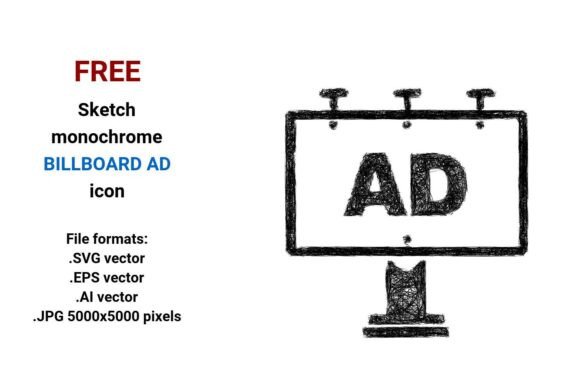
If you’ve ever stared at a blank presentation slide, wrestled with a website wireframe, or tried to sketch out an advertising concept for a client—and wished for a clean, expressive visual shorthand—you’ll appreciate what the FREE Sketch Billboard Ad Icon offers. It’s not just another generic billboard graphic. It’s a hand-drawn, intentionally imperfect line art icon that captures the essence of outdoor advertising: bold, visible, and rooted in real-world spaces like highways, city streets, and suburban corridors.
This set includes four file formats: scalable vector files (.SVG, .EPS, .AI) plus a high-resolution .JPG (5000×5000 pixels). That means whether you’re dropping it into a Figma prototype, layering it into an Adobe Illustrator layout, embedding it in a WordPress sidebar, or printing it on a 24”×36” marketing mood board—it stays crisp, clear, and stylistically consistent.
Why “Sketch” Matters—Especially for Outdoor Billboard Concepts
A vector image isn’t just about scalability—it’s about flexibility in context. The FREE Sketch Billboard Ad Icon leans into line art sketch and hand drawn icon aesthetics for good reason: it signals idea-stage thinking. Unlike photorealistic or glossy ad assets, this icon feels approachable, editable, and human. Designers use it when storyboarding campaign rollouts. Educators drop it into lecture slides about media planning. Freelancers include it in pitch decks to visually anchor “outdoor billboard” without committing to a final creative direction.
Think about it: if you’re mapping how a local bakery might expand visibility beyond Instagram, a roadside billboard icon drawn with pencil-like texture makes the idea feel tangible—not corporate, not distant, but doable. That’s the quiet power of sketchy icon language: it invites collaboration, iteration, and low-stakes exploration.
Where Real People Actually Use These Icons
Small business owners building their first Google Slides pitch deck often struggle to represent “advertising channels” without stock photos or cluttered infographics. A single billboard ad button placed next to icons for social media, radio, and direct mail creates instant visual hierarchy—and communicates channel diversity in under two seconds.
Educators teaching digital marketing or urban design use the roadside billboard icon in worksheets asking students to compare reach, cost-per-impression, and audience targeting across mediums. Because it’s black and white and sketch-style, it avoids unintended cultural or brand associations—keeping focus on structure and strategy, not aesthetics.
Bloggers and content creators covering topics like “low-budget local advertising” or “how billboards still work in 2024” embed the .JPG version directly into articles. Its 5000×5000 resolution ensures sharpness on retina displays and in email newsletters—even when resized responsively. And because it’s free and openly licensed for personal and commercial use, there’s no last-minute copyright panic before hitting “publish.”
UI/UX designers building ad-tech dashboards or campaign management tools use the .SVG version as a lightweight, accessible inline icon. Paired with proper aria-labels, it conveys “outdoor” or “billboard” intent without relying on color alone—a practical win for accessibility and dark-mode interfaces.
What to Consider Before You Download
First: Is “sketch style” right for your project? If you’re designing a luxury brand’s investor report, a rough, pen-drawn aesthetic may clash with tone. But if you’re mocking up a startup’s guerrilla marketing plan—or illustrating a workshop on analog outreach tactics—it adds authenticity and warmth.
Second: Check your software compatibility. While .SVG works everywhere from modern browsers to Figma, .AI files require Adobe Illustrator (or compatible editors), and .EPS may need legacy support in some newer design tools. If you’re unsure, start with the .SVG—it’s universally supported, easy to recolor, and scales flawlessly.
Third: Think about consistency. If your other icons are flat, geometric, and minimalist, dropping in a doodle style icon could disrupt visual rhythm. That’s okay—but do it intentionally. Maybe use the sketch icon only for “concept” or “proposal” states, switching to polished versions once ideas are approved.
More Than Just a Billboard—It’s a Communication Shortcut
The FREE Sketch Billboard Ad Icon doesn’t try to be everything. It doesn’t animate. It doesn’t come with 50 variations. What it does is narrow focus: one clear, recognizable shape representing outdoor billboard, roadside billboard, or simply advertising in public space. That specificity is rare—and useful.
In team settings, it cuts through ambiguity. Instead of saying “let’s explore physical placements,” someone drops the icon into a Miro board with a sticky note: “What if we test this near the I-90 exit?” Instant shared understanding.
For solopreneurs juggling five roles, it saves time. No hunting for royalty-free images. No wrestling with clipping paths. Just download, drag, adjust size or color, and move on—so you can spend energy on messaging, not masking.
And because it’s built as a vector billboard ad, resizing never introduces blur or pixelation. Blow it up for a tradeshow banner? Fine. Shrink it to 24px for a mobile app tab bar? Still legible. That reliability matters when deadlines loom and tools change.
Who Benefits Most—and How
- Freelancers use the billboard ad icon to quickly visualize media mix proposals—especially when clients say “show me how outdoor fits in.”
- Hobbyists and educators print the .JPG version on cardstock, cut it out, and use it in physical marketing simulations or classroom games about audience reach.
- Bloggers and newsletter writers pair the sketch icon with short explanations—e.g., “A roadside billboard icon = high-frequency exposure for commuters”—to reinforce concepts without jargon.
- UX researchers include it in clickable prototypes testing how users interpret advertising channel labels—its simplicity helps isolate comprehension, not design bias.
At its core, the FREE Sketch Billboard Ad Icon is a small tool with a focused job: help people talk, plan, teach, and build around outdoor advertising—without friction, licensing headaches, or visual noise. It’s not flashy. It doesn’t shout. But in the right context—with the right intention—it speaks clearly.